Exactly @Tom71, my mistake, A-2s were horsehide, I was thinking of the G-1 and said the wrong thing. Weird that those G-1s from the '60s look almost blemish free. Bananas.AFAIK, all A-2 were horsehide. However, the M422a/G1 used by the Navy were goat.
I have an Eastman M422a in goat. @Edward perfectly describes the properties: a comparatively light leather but super tough and abrasion resistant.
If you wanted to find a hair in the soup it could be the fact that goat doesn’t really patina. The hide is so tough that it basically stays like new and acquires a somewhat dull appearance over time.
Want to buy or sell something? Check the classifieds
-
The Fedora Lounge is supported in part by commission earning affiliate links sitewide. Please support us by using them. You may learn more here.
You are using an out of date browser. It may not display this or other websites correctly.
You should upgrade or use an alternative browser.
You should upgrade or use an alternative browser.
Experience with Addict Clothes leathers?
- Thread starter greenc
- Start date

Edward
Bartender
- Messages
- 26,337
- Location
- London, UK
AFAIK, all A-2 were horsehide. However, the M422a/G1 used by the Navy were goat.
The original spec for an A2 in 1931, was horsehide, but by wartime they were also being issued in goat. Of the originals which survive, it seems very often the goat ones have lasted longer. The original spec also referred to the seal brown shade if memory serves, though inevitable variances happened along the way as different suppliers interpreted the spec differently.
I remember for many years purists sneering at some more affordable reproductions being made in cowhide... only for Gary Eastman's research mater to suggest that, in fact, many wartime-production A2s were indeed cow.

The USN jackets from the TFL period of interest were always goat - or at least officially so (unless something else was slipped into a wartime production run that hasn't as of yet come to light). There were some later G1s in cow in the 70s I think...?
Does anyone know if Addict uses Shinki horsehide?
I'm not terribly concerned one way or another - and it's certainly not a dealbreaker - it's just that I saw a video on Himel Bros TV (YouTube) in which David describes why he appreciates and uses Shinki for his pieces.
He showed clips from a video he shot while in Japan at the Shinki tannery and then described the special process these hides go through - very cool. He then showed an new jacket in black Shinki that had a really nice pliability - he could bend it and move it around in his hands but it bounced back and wasn't stiff.
He said the hides are 1 - 1.3mm thick and that RMC, Flathead, and other Japanese makers used them. I just don't know if it's a matter of course for most Japanese manufacturers to use them as they're local.
Just curious, thank you.
I'm not terribly concerned one way or another - and it's certainly not a dealbreaker - it's just that I saw a video on Himel Bros TV (YouTube) in which David describes why he appreciates and uses Shinki for his pieces.
He showed clips from a video he shot while in Japan at the Shinki tannery and then described the special process these hides go through - very cool. He then showed an new jacket in black Shinki that had a really nice pliability - he could bend it and move it around in his hands but it bounced back and wasn't stiff.
He said the hides are 1 - 1.3mm thick and that RMC, Flathead, and other Japanese makers used them. I just don't know if it's a matter of course for most Japanese manufacturers to use them as they're local.
Just curious, thank you.

The original spec for an A2 in 1931, was horsehide, but by wartime they were also being issued in goat. Of the originals which survive, it seems very often the goat ones have lasted longer. The original spec also referred to the seal brown shade if memory serves, though inevitable variances happened along the way as different suppliers interpreted the spec differently.
I remember for many years purists sneering at some more affordable reproductions being made in cowhide... only for Gary Eastman's research mater to suggest that, in fact, many wartime-production A2s were indeed cow.
The USN jackets from the TFL period of interest were always goat - or at least officially so (unless something else was slipped into a wartime production run that hasn't as of yet come to light). There were some later G1s in cow in the 70s I think...?
Very informative. I wasn’t aware of the mix in hides, but of course it makes perfect sense in times of elevated demand.
Does anyone know if Addict uses Shinki horsehide?
I'm not terribly concerned one way or another - and it's certainly not a dealbreaker - it's just that I saw a video on Himel Bros TV (YouTube) in which David describes why he appreciates and uses Shinki for his pieces.
He showed clips from a video he shot while in Japan at the Shinki tannery and then described the special process these hides go through - very cool. He then showed an new jacket in black Shinki that had a really nice pliability - he could bend it and move it around in his hands but it bounced back and wasn't stiff.
He said the hides are 1 - 1.3mm thick and that RMC, Flathead, and other Japanese makers used them. I just don't know if it's a matter of course for most Japanese manufacturers to use them as they're local.
Just curious, thank you.
They don’t disclose the tannery.
Of course, Shinki tanned leathers come in all shapes and forms, but the Addict horse doesn’t resemble the Shinki offerings I have tried so far.
Very different grain-structure, different smell when new, a bit less “dry” to the touch (although this is also true for the “oil-tanned” Shinki leathers).
That’s me guessing (with a degree of education, I hope), not knowing.
BTW, one of the most impressive horsehides I have handled is the chrome-tanned hide IronHeart uses for its Cafe Racer. And that is NOT Shinki.
Featured products
-
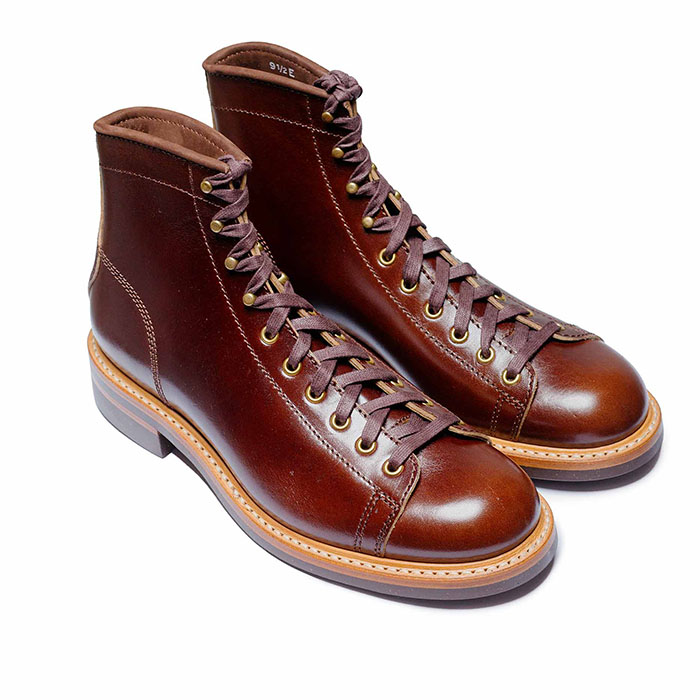 John Lofgren Monkey Boots Shinki Horsebuttt - $1,136 The classic monkey boot silhouette in an incredibly rich Shinki russet horse leather.
 -
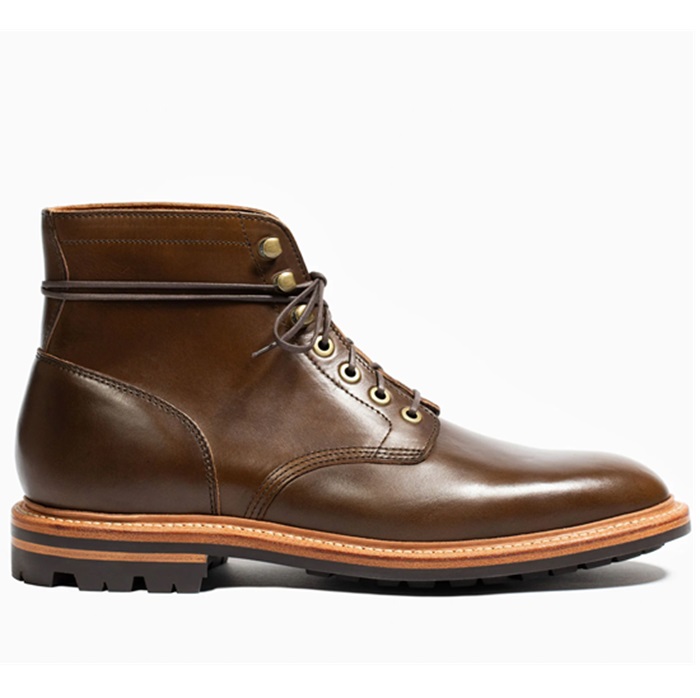 Grant Stone Diesel Boot Dark Olive Chromexcel - $395 Goodyear welted, Horween Chromexcel, classic good looks.
 -
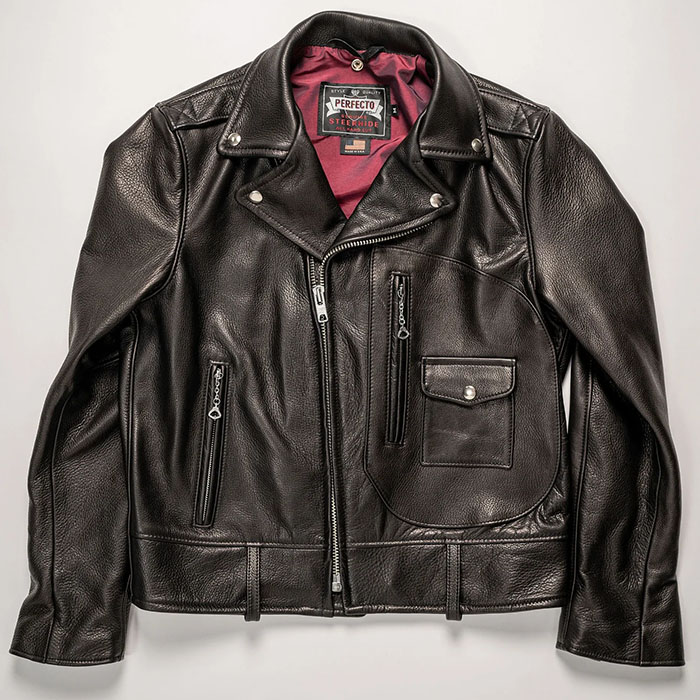 Schott 568 Vandals Jacket - $1,250 The classic Perfecto motorcycle jacket, in a very special limited-edition Schott double rider style.
Thank you @Tom71, there's so much talk all the time about Shinki, but listening to Himel talk about it was really interesting.
I'll check out Iron Heart's offerings, thank you.
I agree. Shinki has got themselves quite a brand name in interested circles.
One is led to believe that it’s actually a product, not a tannery (a very dirty und ecologically questionable endeavour, although the footprint is a bit better with vegetable based tanning methods).
There’s so much rumour about how Shinki distributes their hides based on a customer ranking (with local firms getting the best quality), that one almost believes getting a “Shinki jacket” is a sign of sophistication by itself.
None of that I believe. What I do believe though is that manufacturing and distributing in a niche is always subject to supply and demand fluctuations, and that supply chains in general are under severe duress and have been at least since COVID (with tariff issues elevating that issue to the next level).
Edward
Bartender
- Messages
- 26,337
- Location
- London, UK
Thank you @Edward I appreciate the clarification. The Vintage Leather Jacket forum guys get into great discussions about such thing. The wartime contracts were an interesting time - everyone pitching in to help and do their part.
Very much so, though I'm sure the value of a big, government contract at the time didn't hurt at all. (Especially if consumer spending was down due to the war, even if it impacted less directly on the US home front than over here, for obvious reasons.)
I agree. Shinki has got themselves quite a brand name in interested circles.
One is led to believe that it’s actually a product, not a tannery (a very dirty und ecologically questionable endeavour, although the footprint is a bit better with vegetable based tanning methods).
There’s so much rumour about how Shinki distributes their hides based on a customer ranking (with local firms getting the best quality), that one almost believes getting a “Shinki jacket” is a sign of sophistication by itself.
None of that I believe. What I do believe though is that manufacturing and distributing in a niche is always subject to supply and demand fluctuations, and that supply chains in general are under severe duress and have been at least since COVID (with tariff issues elevating that issue to the next level).
Shinki have been very effective in the way they've built up and sold their brand. The examples I've handled were nice, though personally I still prefer my Horween hides. I do remember at one point Aero looked at using Shinki, but as memory serves word was the tannery couldn't commit to the sort of quantities Aero would have been looking for for a stock hide. If my memory of the timeline is correct, that's when Aero then brought in the Italian Vicenza hide, which is a lovely alternative to FQHH for those who want something that doesn't require any break-in.
Edward
Bartender
- Messages
- 26,337
- Location
- London, UK
@Edward I just learned something - I didn't know that Vicenza didn't really require a break-in period.
Is Vicenza not FQHH? Am I mistaken in thinking that all horsehide used in leather jackets is FQHH? What other part of the horse does it come from?
No, when I say FQHH I mean the Horween CXL FQHH, which is hefty stuff indeed. Not as much as some would have you believe - I've never needed more than a month of daily wear to break in a jacket made of it - but it does need a break in. I don't know what part of the horse the Vicenza comes from to be honest, but it drapes noticeably softer than the CXL stuff. The different tanning process I think also has much to do with it.
Thanks for the clarification @Edward, I have heard that the Horween CXL is indeed very stiff - by chance do you know what the Vanson HH was/is?
I've seen photos of older HH Vanson jackets that still stand up on the own after years of wear. Seems they never actually soften.
I've seen photos of older HH Vanson jackets that still stand up on the own after years of wear. Seems they never actually soften.
Edward
Bartender
- Messages
- 26,337
- Location
- London, UK
Thanks for the clarification @Edward, I have heard that the Horween CXL is indeed very stiff - by chance do you know what the Vanson HH was/is?
I've seen photos of older HH Vanson jackets that still stand up on the own after years of wear. Seems they never actually soften.
Vanson I've not owned - plenty of folks on here can fill you in on those, though.
The Horween CXL FQHH is stiff when it first arrives, though imo its armour-like properties have been somewhat over-exaggerated. Never taken me more than a month of regular wear to break one in.
I think there is a huge difference between horse skin and goat skin.The original spec for an A2 in 1931, was horsehide, but by wartime they were also being issued in goat. Of the originals which survive, it seems very often the goat ones have lasted longer. The original spec also referred to the seal brown shade if memory serves, though inevitable variances happened along the way as different suppliers interpreted the spec differently.
I remember for many years purists sneering at some more affordable reproductions being made in cowhide... only for Gary Eastman's research mater to suggest that, in fact, many wartime-production A2s were indeed cow.
The USN jackets from the TFL period of interest were always goat - or at least officially so (unless something else was slipped into a wartime production run that hasn't as of yet come to light). There were some later G1s in cow in the 70s I think...?
Edward
Bartender
- Messages
- 26,337
- Location
- London, UK
I think there is a huge difference between horse skin and goat skin.
Horse and goat, yes. Horse and cow, though, not so much. It's a lot of what had previously been assumed to be horse that the Eastman research claimed to be cow instead. Definitely found a difference between the goat and the horse, though. At a time I owned both an Eastman and an Aero A2, the former horse, the latter goat. Once I had the goat I almost never worse the horse at all. both a variation on the seal brown. When I outgrew the A2, I sold it on ebay. Turned out the buyer was none other than Ken himself, who was gonig to replace the knits (which got badly motheaten in storage). Nice to send it back home.
braxtonhicks
New in Town
- Messages
- 5
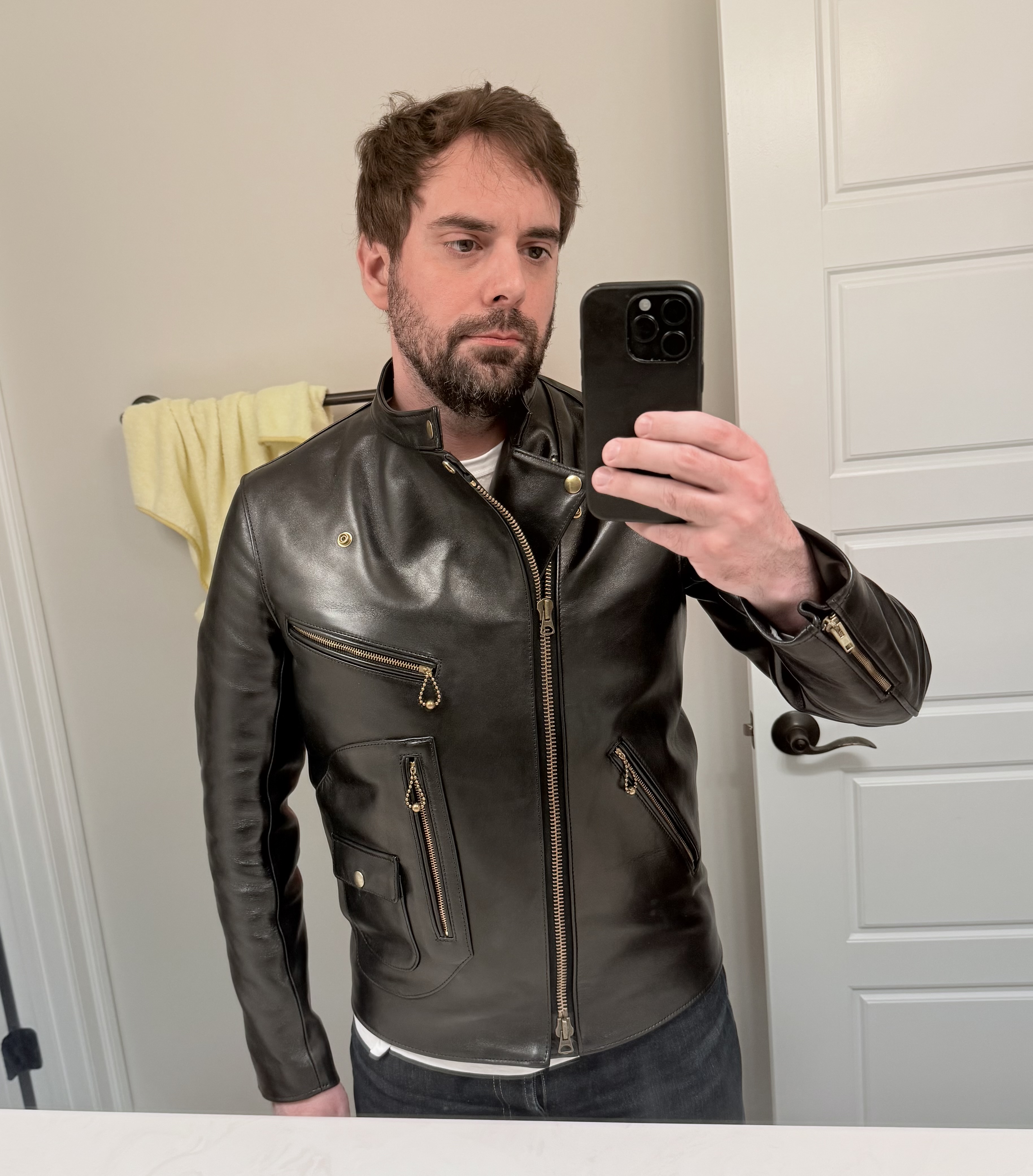
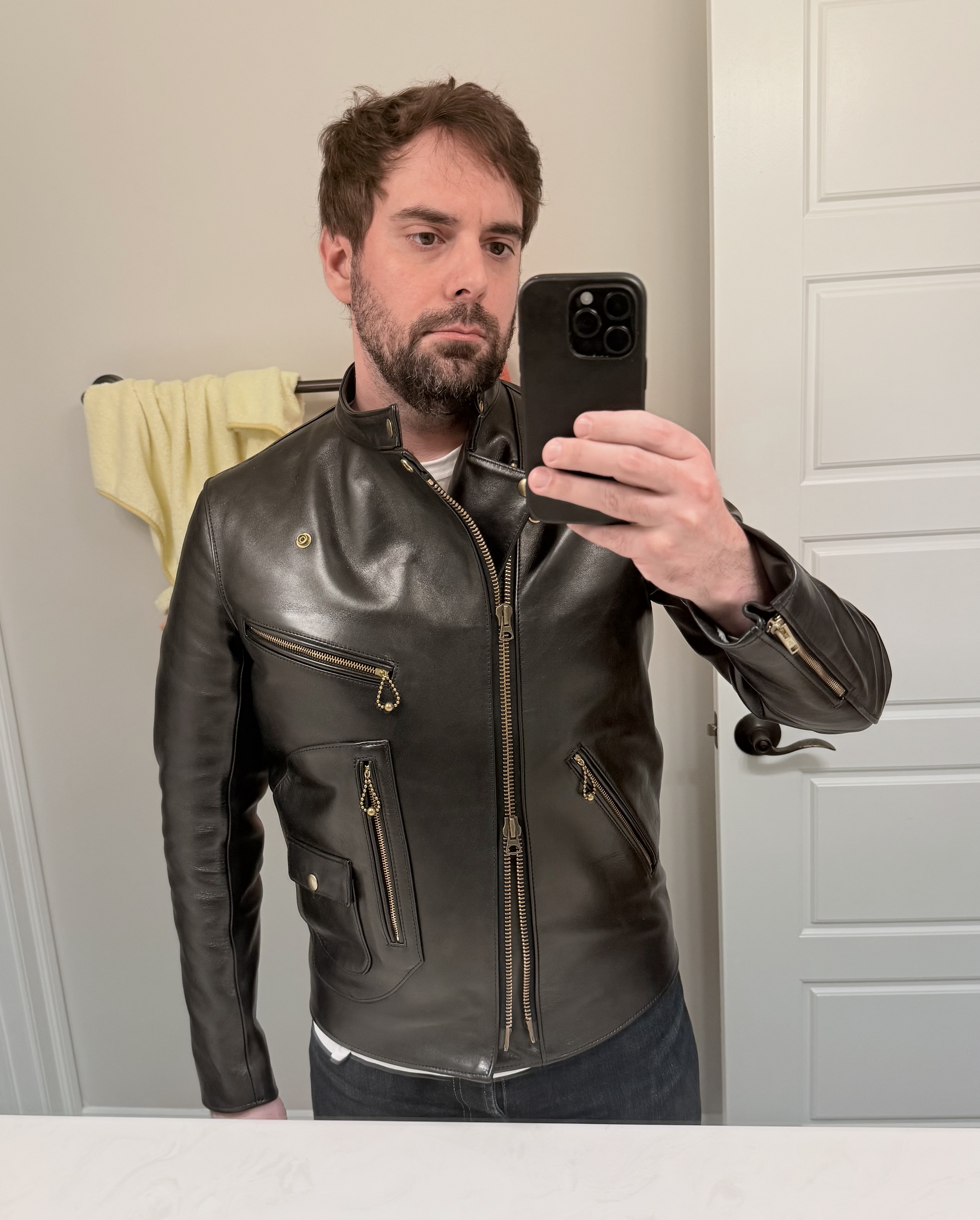
I’ve got a size 40 Tri jacket I’m just starting to break in at 5’9 185lb.
Previously had one of the Schott/Context CXL113s, a Vanson Portland, and a Fine Creek 2mm Leon Custom.
This Addict jacket is stiff, but the pattern suits a 185lb frame well. Interesting split between cafe collar and double rider. I like my jackets snug with a t-shirt or a light hoodie and this does the trick.
The sleeves are snug, whereas on other jackets above I always had space in the wrist that I disliked. This isn’t broken in yet with two weeks of wear, but already it fits night and day better than the Fine Creek and the Schott without alterations. I now love double zips and this leather feels so good even stiff on the skin.
The only downsides are only one pocket, and Japanese pockets kind of ****. They are too high to really be useable.
On the whole pre-break in, I like the fit and finish so much, I’m on the hunt for another in an AD-02L model.
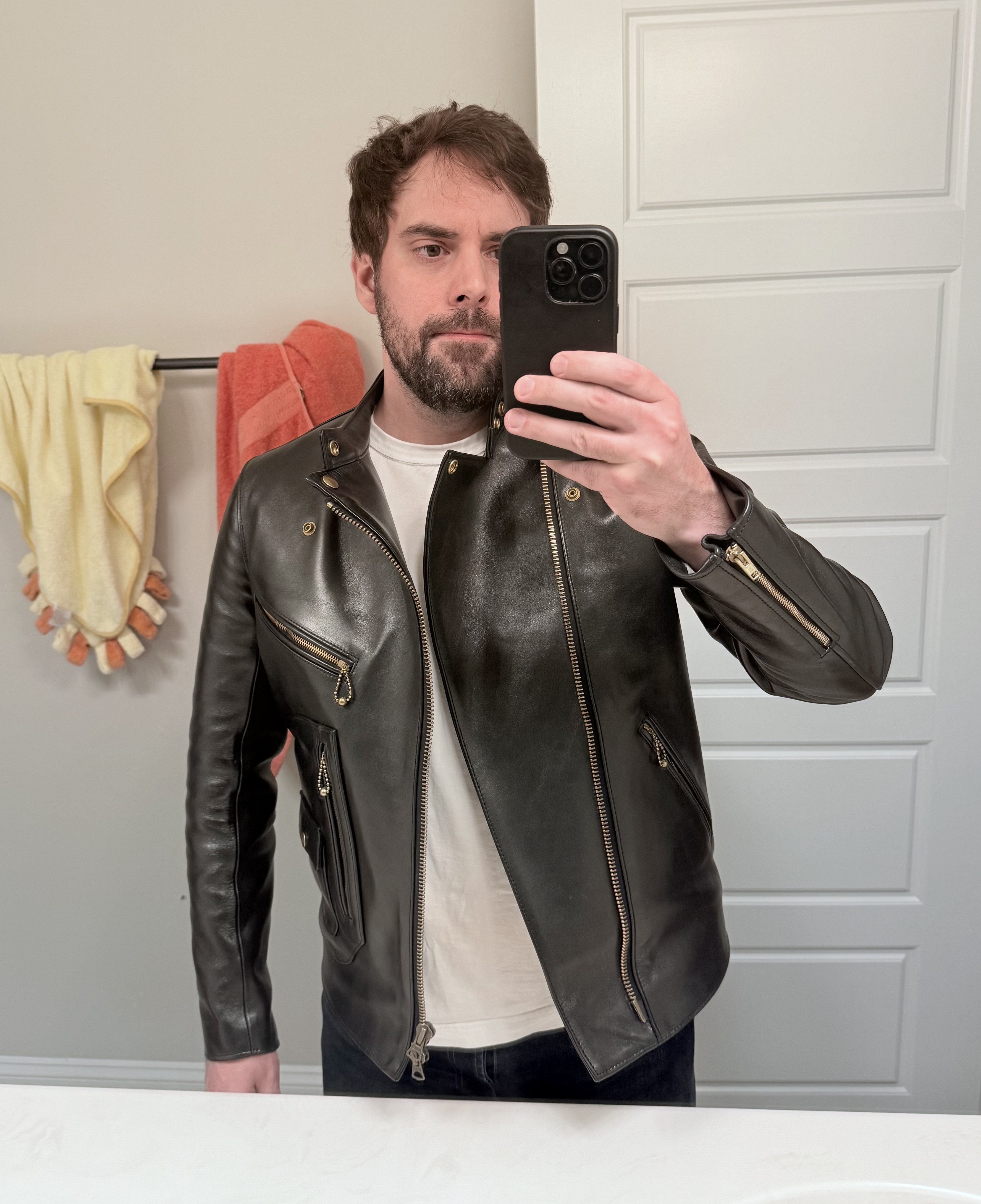
Previously had one of the Schott/Context CXL113s, a Vanson Portland, and a Fine Creek 2mm Leon Custom.
This Addict jacket is stiff, but the pattern suits a 185lb frame well. Interesting split between cafe collar and double rider. I like my jackets snug with a t-shirt or a light hoodie and this does the trick.
The sleeves are snug, whereas on other jackets above I always had space in the wrist that I disliked. This isn’t broken in yet with two weeks of wear, but already it fits night and day better than the Fine Creek and the Schott without alterations. I now love double zips and this leather feels so good even stiff on the skin.
The only downsides are only one pocket, and Japanese pockets kind of ****. They are too high to really be useable.
On the whole pre-break in, I like the fit and finish so much, I’m on the hunt for another in an AD-02L model.
Similar threads

- Replies
- 1
- Views
- 301
- Replies
- 8
- Views
- 1K