Want to buy or sell something? Check the classifieds
  • The Fedora Lounge is supported in part by commission earning affiliate links sitewide. Please support us by using them. You may learn more here.

Men rings - How to choose? What do you wear?

Messages
15,272
Location
Buffalo, NY
Nice surface and color, and a pretty robust bamboo-style ring. I like my rings pretty large myself. Do you find the edges to be uncomfortable against your other fingers? I might have softened those in the model or in finishing...although those crisp rims do give a nice effect visually.
Thanks for the comments. I am aware of edges from time to time. I burnished them myself just a wee bit but I’ll wear it for a good while before doing more. It’s not an everyday wear. The platinum band posted a while back is more forgiving for days when I might be using my hands for work projects.
 
Last edited:

KimNelson

New in Town
Messages
23
Holiday shopping has a dangerous habit of bringing me into jewelry shops. We have a new store that opened a couple of years back at the end of our street. He has done a few repairs for us that turned out well and I decided to work with him on a custom project that will repurpose some material handed down from my parents. In discussing the project, which will be made in 24K gold, he showed me a ring from his estate case that intrigued me... a simple and somewhat rustic band of .95 platinum. I've always enjoyed the weight of platinum and have a band my wife bought for me many years ago. This one is quite a bit larger and heavier - 24 grams - but comfortable and warm on the hand. Platinum is not the easiest metal to work or to keep polished... this piece has considerable patina and should shrug off the slings and arrows that will accumulate from frequent wear.

View attachment 677554

View attachment 677553

Haven't had much luck searching the origin though from the hallmarks it appears to have been sold in the UK.

View attachment 677552
This would be a comfortable ring for regular wear. Hallmarking isn't that common in the US anymore, so it's nice to have the documentation. I don't own any platinum pieces, but with the current price of gold being what it is, my clients are starting to ask for it. I'm not a fan of plating...for platinum or white gold...my favorite white is 18k palladium. Here in the states, not many folks are familiar with the deeper tones of unplated platinum, since everything over here gets a coat of rhodium, but I think there's something very lustrous about natural pt.
 

KimNelson

New in Town
Messages
23
I've had a chance to go back and read more of the earlier posts, and felt like posting more on the topic. Most of my work in the industry is now private client work specifically in men's rings which have become my niche. These clients are mostly looking for very important, high jewelry pieces, which can impose certain guard rails, but not always. I grew up in a very conservative (some would say the most conservative) part of a fairly conservative country...at least in terms of men's fashion...so all of the men I grew up around were wedding band only, working class guys. My maternal grandfather was pretty wealthy, and he did own one diamond fashion ring, which we in the trade would call a cluster-style mounting where 9 small stones (melee) were lined up in rows to create the impression of a faux, ring-size diamond. It's a long and winding story how I ended up being a recognized jewelry designer in NYC, and I'll spare you the details. What I will say is that men can and should wear as much jewelry as they want; bling is not a barometer of machismo or masculinity, anymore than wearing bright colors—or a fedora—would be. Being noticed isn't a bad thing, and jewelry, particularly rings, are a very intimate and personal statement that can carry significant personal meaning and bring pleasure and satisfaction for decades. I ALWAYS wear rings when I leave the house. (Would you trust a skinny pastry chef?), and my jewelry functions as business cards as well as items of personal adornment. I've never understood small jewelry, so all of my rings are large except for two: a 1917 color fashion ring I inherited from my paternal grandfather, and a sapphire/diamond men's bridal piece I designed 20 years ago that I now wear as a thumb ring. I'm twice divorced—bust just crazy enough to try again—so I don't wear a wedding ring. In fact, my left ring finger is a favorite location for non-wedding rings, just because it's my non-dominant hand and a comfortable location for rings.

Advice:
I think that bands less than 3mm wide look too delicate on most men.
Shanks over 4mm wide half way down the finger (3 and 9 o'clock) can be uncomfortable...particularly if you have pronounced webbing between your fingers and if the design features sharp rims.
Vintage styles often taper to under 2mm under the finger (6 o'clock), which can be a problem for rings with a symmetrical center stone, because the narrow shank is insufficient to keep the ring from tilting on your finger and looking wonky. Such rings work best on the outside of the hand—pinky or index fingers—where the tilting will be less noticeable.
Rings that raise more than 10mm off the finger can be problematic in that they will tend to get smacked around and catch on things. (Some of my personal rings exceed this, but I am aware of this element when designing for clients.)
Opal, tourmaline, tanzanite. beryl (aquamarine, and emerald) and many hardstones (jewelry speak for opaque semiprecious materials...that are ironically rarely very hard) such as turquoise and lapis are sensitive to impact, temperature, and chemicals, so wear them accordingly.
Corundum (rubies and sapphires), garnets, jades, and many agates are tough enough to be worn and cleaned without much concern for durability. Diamonds are the hardest gemstone, but that just means they can scratch everything else, and nothing else can scratch them. Diamonds are NOT tough; they are actually pretty brittle and can cleave and chip quite easily if struck in a way that impacts cleavage planes, etc.
Consider using lab grown materials when you can; they are chemically indistinguishable from their natural counterparts, and will ALWAYS look better than the natural materials most of us can afford. Unless you are buying pieces as an investment (unless you're looking at diamonds...which are almost never a decent investment regardless), you will get much more bang for your buck from lab grown stones. (And keep in mind that I am an unapologetic jewelry snob to an embarrassing degree).
If you have the choice, always take black jade over onyx :).

Note: the bold font is just to visually separate ideas, and not for emphasis; I couldn't find a way to do ******s, lol!

If you have any jewelry questions, don't hesitate to reach out; if I don't have the answer, I know somebody who does.

I will post pics in the coming days.
 

Peacoat

Bartender
Messages
7,088
Location
South of Nashville
I've had a chance to go back and read more of the earlier posts, and felt like posting more on the topic. Most of my work in the industry is now private client work specifically in men's rings which have become my niche. These clients are mostly looking for very important, high jewelry pieces, which can impose certain guard rails, but not always. I grew up in a very conservative (some would say the most conservative) part of a fairly conservative country...at least in terms of men's fashion...so all of the men I grew up around were wedding band only, working class guys. My maternal grandfather was pretty wealthy, and he did own one diamond fashion ring, which we in the trade would call a cluster-style mounting where 9 small stones (melee) were lined up in rows to create the impression of a faux, ring-size diamond. It's a long and winding story how I ended up being a recognized jewelry designer in NYC, and I'll spare you the details. What I will say is that men can and should wear as much jewelry as they want; bling is not a barometer of machismo or masculinity, anymore than wearing bright colors—or a fedora—would be. Being noticed isn't a bad thing, and jewelry, particularly rings, are a very intimate and personal statement that can carry significant personal meaning and bring pleasure and satisfaction for decades. I ALWAYS wear rings when I leave the house. (Would you trust a skinny pastry chef?), and my jewelry functions as business cards as well as items of personal adornment. I've never understood small jewelry, so all of my rings are large except for two: a 1917 color fashion ring I inherited from my paternal grandfather, and a sapphire/diamond men's bridal piece I designed 20 years ago that I now wear as a thumb ring. I'm twice divorced—bust just crazy enough to try again—so I don't wear a wedding ring. In fact, my left ring finger is a favorite location for non-wedding rings, just because it's my non-dominant hand and a comfortable location for rings.

Advice:
I think that bands less than 3mm wide look too delicate on most men.
Shanks over 4mm wide half way down the finger (3 and 9 o'clock) can be uncomfortable...particularly if you have pronounced webbing between your fingers and if the design features sharp rims.
Vintage styles often taper to under 2mm under the finger (6 o'clock), which can be a problem for rings with a symmetrical center stone, because the narrow shank is insufficient to keep the ring from tilting on your finger and looking wonky. Such rings work best on the outside of the hand—pinky or index fingers—where the tilting will be less noticeable.
Rings that raise more than 10mm off the finger can be problematic in that they will tend to get smacked around and catch on things. (Some of my personal rings exceed this, but I am aware of this element when designing for clients.)
Opal, tourmaline, tanzanite. beryl (aquamarine, and emerald) and many hardstones (jewelry speak for opaque semiprecious materials...that are ironically rarely very hard) such as turquoise and lapis are sensitive to impact, temperature, and chemicals, so wear them accordingly.
Corundum (rubies and sapphires), garnets, jades, and many agates are tough enough to be worn and cleaned without much concern for durability. Diamonds are the hardest gemstone, but that just means they can scratch everything else, and nothing else can scratch them. Diamonds are NOT tough; they are actually pretty brittle and can cleave and chip quite easily if struck in a way that impacts cleavage planes, etc.
Consider using lab grown materials when you can; they are chemically indistinguishable from their natural counterparts, and will ALWAYS look better than the natural materials most of us can afford. Unless you are buying pieces as an investment (unless you're looking at diamonds...which are almost never a decent investment regardless), you will get much more bang for your buck from lab grown stones. (And keep in mind that I am an unapologetic jewelry snob to an embarrassing degree).
If you have the choice, always take black jade over onyx :).

Note: the bold font is just to visually separate ideas, and not for emphasis; I couldn't find a way to do ******s, lol!

If you have any jewelry questions, don't hesitate to reach out; if I don't have the answer, I know somebody who does.

I will post pics in the coming days.

• To make a ****** on a Mac, press "Option" "8". That's a solid ****** •. There is a way to make a hollow ******, but I have forgotten how. It may be "Option" "Shift" "8". ° Yep, that did it.
 

rogueclimber

One Too Many
Messages
1,312
Location
Marina del Rey
• To make a ****** on a Mac, press "Option" "8". That's a solid ****** •. There is a way to make a hollow ******, but I have forgotten how. It may be "Option" "Shift" "8". ° Yep, that did it.

Though I consider that the 'degree' symbol as in

"Damn it's hot: 74°"

(Southern CA on the ocean, that is hot! LOL)
 

AHP91

One Too Many
Messages
1,477
Picked up another of these rings, based on some research this is a novelty ring from the 40s/50s. Cool design, the eyes glisten in the ligt.

m40127427210_1.jpg


img_1489-png.687120
 

KimNelson

New in Town
Messages
23
Picked up another of these rings, based on some research this is a novelty ring from the 40s/50s. Cool design, the eyes glisten in the ligt.

m40127427210_1.jpg


img_1489-png.687120
These are a testament to the durability of jewelry items...even less expensive, promotional pieces like this one. I would caution that this ring is most likely what we in the trade call "white metal," which back in the 40's and 50's would have been an alloy containing lead and tin...back before the risks of lead were well understood. I probably wouldn't wear this as an everyday piece.
 

KimNelson

New in Town
Messages
23
Next up, a ring with a story. One of my favorite things about jewelry—and a big influence on my choosing it as my art medium—is its longevity, it's ability to carry echoes.

10K yellow and white gold, with lab-grown blue spinel.
IMG_4605.jpg
IMG_4606.jpg


This ring belonged to my Danish grandfather. When he passed, he had actually left me his violin, since I was his most musically inclined grandchild, but my Aunt believed the violin...being Danish and all...must have been worth money, and since the only witnesses to Granddad's wishes were me and my father, she took it. My dad felt badly enough about this to give me his father's ring.

The story went that Grandpa got the ring in Paris while he was on leave during WWI. He was in the Corps of Engineers, and spent the war either making trenches or fighting from them. He suffered from lungs damaged by mustard gas and shrapnel that was never properly removed as keepsakes from that war...as well as this ring.

It was nice to have something of his, but as a young man I wasn't much into jewelry yet, and if I had been, I would have picked something a whole lot edgier than this "gentlemen's ring." Besides, it was badly worn; the stone looked like a gumdrop a toddler had gnawed at, without any of the top facets it once had, and there were nicks and scratches all over the mounting. So I kept in in a drawer, only pulling it out when I wanted to remember the dignified old man who once wore it.

Fast forward two decades. I was working as designer at one of the finest jewelry houses in the United States. The president of this firm, Andre', had left France following WWII to bring his family's jewelry traditions to this country. Like many of the tradesmen and craftsmen who created and expanded New York City's diamond district, he was part of the European Jewish diaspora that came here for a safer and better life.

I happened to have the ring with me that particular day, because I'd just taken it to an appraiser to see what it was, and what it might be worth. I showed it to Andre' and shared the familial story regarding its provenance. Andre' interrupted me and stuck out his hand. As we shook, he became fairly emotional (for Andre') and thanked me for my family's sacrifice in protecting his home country. He then informed me that my family had it wrong: the ring was most certainly not French as it was stamped 10k, and the French had NEVER used 10K gold! He informed me that the ring was bought in England, where 10k was popular. He then asked if he could hold on to the ring for a few days. When he returned it, the ring looked like it came from 1987 instead of 1917: he'd had the shop pull the stone and had our in-house lapidaries recut the spinel. He then had his head jeweler dress out and refinish the mounting, before resetting the stone.

As for what it was worth? Not much: the stone was a lab-grown spinel, and the mounting was mass-produced using die-striking. The appraiser said that he'd list it at $60 for insurance purposes. The ring is a fascinating study in early 20th century jewelry, however. 10k gold is less than 50% gold, which makes it a fairly hard metal, and die striking creates a very thin metal body that behaves more like steel than precious metal. This went a long ways towards it holding up so well for more than 100 years. The lab-grown spinel was a mystery, because lab-grown spinels were supposedly unavailable prior to 1920, and yet we know my grandfather never returned to the UK or Europe after the war...so his 1917 purchase date was likely accurate. Also, when lab-grown stones were first available they were extremely valuable and sought after due to the fixation on science at the time, combined with the novelty of a man-made gem that was chemically identical to what nature had to offer. Grandpa would have paid considerably more for this lab-grown spinel than he would have for a natural one.

I have finally aged into the style of this ring, and now wear it fairly regularly. It is very light weight with a narrow shank that makes it one of my most comfortable rings. And I'm very fond of the stories it carries.
 

KimNelson

New in Town
Messages
23
What a meaningful and fascinating story! It’s incredible how a piece of jewelry can carry so much history, personal significance, and connection to the past. The restoration process brings it back to life, and now it seems to hold both the memories of your grandfather and the craftsmanship of your journey as a designer. It’s nice that the ring is finally getting the appreciation it deserves.
Thanks Vogera!

I actually got to see my old mentor last week; He has decided to close shop after 71 years of crafting the highest jewelry in the country. I was FANTASTICALLY fortunate to apprentice under him. Three more pics for the story...

Granddad in his WWI uniform...the young man who bought the ring...
Grandpa Joe Nelson.jpg


Me with my mentor in-house in the mid 90's...
Andre.jpg


And us together again, just last week...
View attachment W Andre Party.JPG

I've never met a better eye, a finer gentleman, or more consummate craftsman.
 

MrX94

New in Town
Messages
14
I'm pretty picky when it comes to rings. I find most designs to be too simple or too gaudy. I found a good mix of design and quality in Good Art Hlywd. I like their motifs, like flowers and hearts.
 

Attachments

  • Rings.jpg
    6.9 MB · Views: 46

ShadowXY

One of the Regulars
Messages
117
Location
So Cal, USA
I've had a chance to go back and read more of the earlier posts, and felt like posting more on the topic. Most of my work in the industry is now private client work specifically in men's rings which have become my niche. These clients are mostly looking for very important, high jewelry pieces, which can impose certain guard rails, but not always. I grew up in a very conservative (some would say the most conservative) part of a fairly conservative country...at least in terms of men's fashion...so all of the men I grew up around were wedding band only, working class guys. My maternal grandfather was pretty wealthy, and he did own one diamond fashion ring, which we in the trade would call a cluster-style mounting where 9 small stones (melee) were lined up in rows to create the impression of a faux, ring-size diamond. It's a long and winding story how I ended up being a recognized jewelry designer in NYC, and I'll spare you the details. What I will say is that men can and should wear as much jewelry as they want; bling is not a barometer of machismo or masculinity, anymore than wearing bright colors—or a fedora—would be. Being noticed isn't a bad thing, and jewelry, particularly rings, are a very intimate and personal statement that can carry significant personal meaning and bring pleasure and satisfaction for decades. I ALWAYS wear rings when I leave the house. (Would you trust a skinny pastry chef?), and my jewelry functions as business cards as well as items of personal adornment. I've never understood small jewelry, so all of my rings are large except for two: a 1917 color fashion ring I inherited from my paternal grandfather, and a sapphire/diamond men's bridal piece I designed 20 years ago that I now wear as a thumb ring. I'm twice divorced—bust just crazy enough to try again—so I don't wear a wedding ring. In fact, my left ring finger is a favorite location for non-wedding rings, just because it's my non-dominant hand and a comfortable location for rings.

Advice:
I think that bands less than 3mm wide look too delicate on most men.
Shanks over 4mm wide half way down the finger (3 and 9 o'clock) can be uncomfortable...particularly if you have pronounced webbing between your fingers and if the design features sharp rims.
Vintage styles often taper to under 2mm under the finger (6 o'clock), which can be a problem for rings with a symmetrical center stone, because the narrow shank is insufficient to keep the ring from tilting on your finger and looking wonky. Such rings work best on the outside of the hand—pinky or index fingers—where the tilting will be less noticeable.
Rings that raise more than 10mm off the finger can be problematic in that they will tend to get smacked around and catch on things. (Some of my personal rings exceed this, but I am aware of this element when designing for clients.)
Opal, tourmaline, tanzanite. beryl (aquamarine, and emerald) and many hardstones (jewelry speak for opaque semiprecious materials...that are ironically rarely very hard) such as turquoise and lapis are sensitive to impact, temperature, and chemicals, so wear them accordingly.
Corundum (rubies and sapphires), garnets, jades, and many agates are tough enough to be worn and cleaned without much concern for durability. Diamonds are the hardest gemstone, but that just means they can scratch everything else, and nothing else can scratch them. Diamonds are NOT tough; they are actually pretty brittle and can cleave and chip quite easily if struck in a way that impacts cleavage planes, etc.
Consider using lab grown materials when you can; they are chemically indistinguishable from their natural counterparts, and will ALWAYS look better than the natural materials most of us can afford. Unless you are buying pieces as an investment (unless you're looking at diamonds...which are almost never a decent investment regardless), you will get much more bang for your buck from lab grown stones. (And keep in mind that I am an unapologetic jewelry snob to an embarrassing degree).
If you have the choice, always take black jade over onyx :).

Note: the bold font is just to visually separate ideas, and not for emphasis; I couldn't find a way to do ******s, lol!

If you have any jewelry questions, don't hesitate to reach out; if I don't have the answer, I know somebody who does.

I will post pics in the coming days.
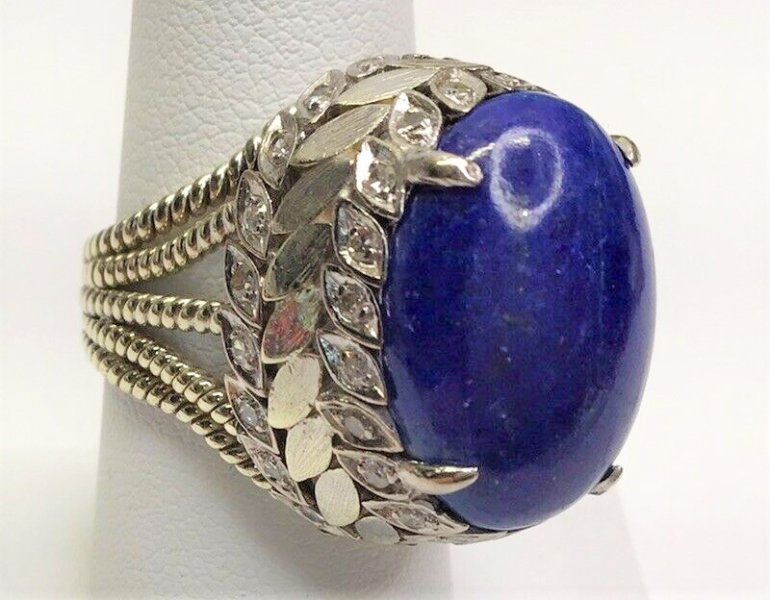
I studied Gemology & Jewelry in NY too. Went to FIT for a few courses (Jewelry Appraisal, Gem Lab & Diamond Grading). It's just my passion & has been since I was a child. I used to spend lunch hours at my friends FIL's Pawn shop in NY. Picked up many nice things in the late 80's 90's. I still pick up things on the bay...

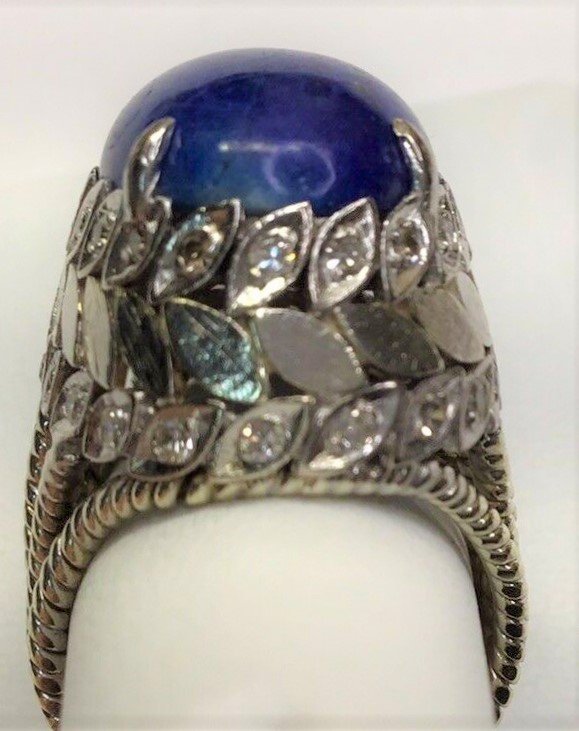
What do you think of this Lapis? A recent splurge but there is much work in it & it's a huge ring.
I like the older Jewelry Deco up until about 60's. After that most was junk & is junk unless you do the custom high end pieces. I love Platinum & Palladium was a 40's thing at one time. Don't like yellow gold.

Well, for the ladies...
 

Attachments

  • lapis 14 k wg  s-l1600 (2).jpg
    lapis 14 k wg s-l1600 (2).jpg
    133.8 KB · Views: 49
  • lapis ring 14.6 g ,5 dia 14kwg s-l1600 (3).jpg
    lapis ring 14.6 g ,5 dia 14kwg s-l1600 (3).jpg
    105.5 KB · Views: 44

Forum statistics

Threads
114,716
Messages
3,180,962
Members
58,561
Latest member
1930sMenswearEnthusiast
Top