Guppy
I'll Lock Up
- Messages
- 4,536
- Location
- Cleveland, OH
Thank you for explaining yourself.@Guppy I appreciate you posting about this - always a pleasure to read your stuff! Not sure what you mean by "to seek contrary opinions" though, feel free to elaborate.
Here are some reasons (all very subjective and debatable obviously):
1 . Tasteless distressing and selling jackets that already make to look dirty. This does not vibe with me AT ALL, similar to how buying jeans with holes in them is just silly to me. I feel like they had more options in this regard in the past, maybe toned down by now, but you can still find them.
View attachment 717274
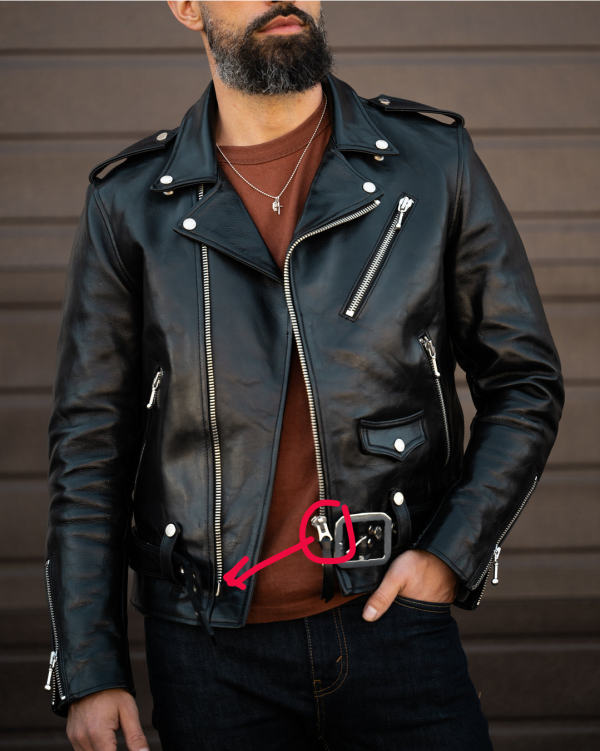
2 . The extremely cringe uber macho modeling / marketing again does not vibe well with me. Similar story with their marketing videos and product descriptions.
View attachment 717269
View attachment 717272
View attachment 717273
3 . I remember them (indirectly) ****ting on other makers / manufacturers like RW to promote their own stuff. Can't find examples now and maybe they removed the comments on IG.
4 . Sending "influencers" free jackets to promote their products.
5 . Advertising their stuff everywhere - I've seen ads on IG, FB, etc..
6 . This video by our own @Mrfrown also made me dislike them rather more than less:
Nice cherry on top - this clown praising them:
https://www.tiktok.com/video/7206887752724483333
I could go on but that's enough. Again - everyone can make up their own opinion, this is only mine.
Also quite a lot has been discussed here (thread now closed thanks to one very motivated MSC shill):
https://www.thefedoralounge.com/threads/master-supply-co.110319/
To explain what I meant by seeking contrary opinions, what I was asking for was reasons against buying their product. For me that comes down to the product itself, whether it is made well, of quality materials and methods, priced reasonably, represented accurately, etc.
If I'm reading you right, your reasons are less to do with the product itself, and more to do with marketing/image and business practices. Which, those are legitimate reasons, or can be, as well. But they're not directly attached to the product itself.
One way to think about my question is, if you were to find the jacket on the rack at a store, and you didn't know anything about the company that made it, what would you think of the jacket itself? Or, maybe, if you had opportunity to buy one secondhand, so your money would not be supporting the business practices of the company, would you consider it a quality product worth owning for the price? Or, still another way to put it: If you can imagine 50-60 years into the future, finding this jacket at a vintage clothing store, long after any of the branding and cultural baggage is long-forgotten, how would it compare to other vintage leather jackets of the same age and price range?
In the real world, of course, you can't easily divorce business practices and products. Brands do have images and these communicate something through associations between the customer and the brand image cultivated by the business, whether through their marketing or the "behind the scenes" operations and practices that they may or may not be promoting.
Considering the reasons you've shared:
1. I find artificial aging to be distasteful most of the time, unless it's done very well and looks natural rather than artificial. It's a subjective thing, but I don't mind certain things, while others seem distasteful, or inauthentic. Like, Thedi does an amazing job of giving their leathers a worn appearance, but I don't care for Eastman's "Time Worn" treatment. The sort of distressing you'll find on mall jackets is especially fake looking once you know what real wear and patuna looks like, and all that artificial wear is poseur-ish. So I get all that, and for the most part I am in agreement.
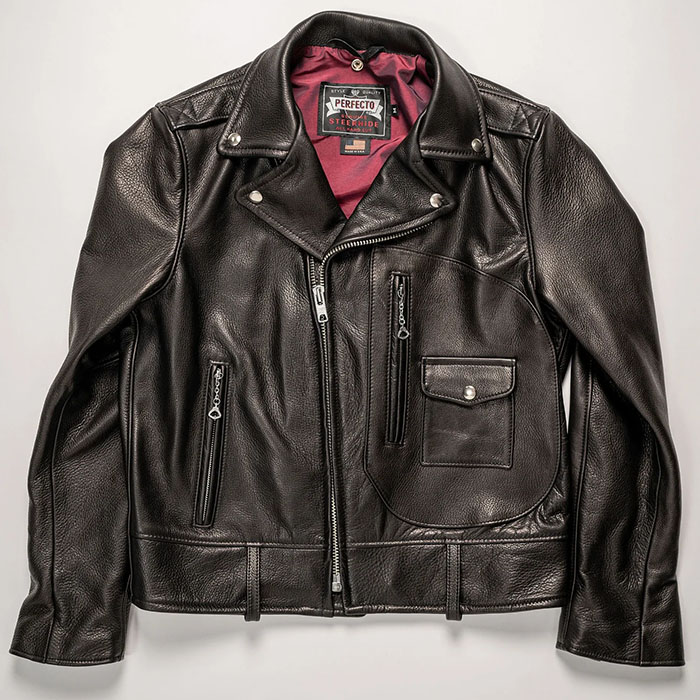
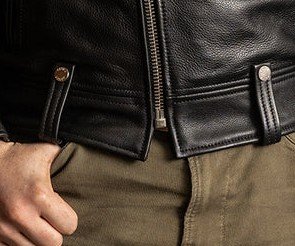
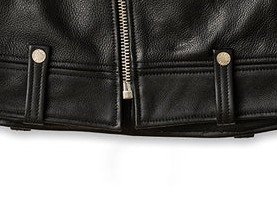
But the specific jacket I'm considering doesn't have artificial aging. On top of that, it's a vegetable tanned leather, so it seems that they have upped their game with what they are offering with this model.
Now, you might object to artificial aging so strongly that as a matter of principle, you wouldn't buy ANY product from a company that once offered it, or that offers artificial aging on other current products. But I'm looking at just this product.
2. The models are very macho/masculine, yes. Maybe it's a bit overdone, to the point of being performative. There's a lot of, let's say, BS wrapped up in how both masculinity and femininity have been sold to the public over many decades, by advertisers and marketers, and I think it is right to be critical of that.
If you get sucked into the marketing message, you'll buy clothes because they made the model look good in the marketing materials, and not necessarily how they'll look on you. Even though you're really buying for you. The more pertinent question is, ignore the model -- how's it going to look on you? Will it look good on you, will it make you look good? Will you feel like yourself, or will you feel like you're wearing a costume? Do you want to fit in, or do you want to stand out? There's no right or wrong way to answer those types of questions for yourself. But certainly, if the models and the choices made by the brand to represent the products they way they do don't speak to you, or actively turn you off, then of course you wouldn't be inclined to buy it.
3. The advertisements, social media ad buys, social media influencers, and reviews by shills. MSC do seem to be campaigning on Facebook and Instagram heavily right now. Like it or not, for better or worse, that's how I found out about the brand.
Now, I really don't like advertising. I hate that businesses intrudes into my life, always wanting my money, and I hate that they gather information about me, invading my privacy in order to analyze who I am in order to craft messages that I'm likely to be more susceptible to, in order to get me to send them my money.
On the other hand, companies do exist to make money, in order to sell product people need to know about them, and occasionally companies make things I do need or want, and somehow or other if I don't find out about it, I'll miss out on it.
I do notice that a lot of the advertisement I get through Facebook is for **** products: drop shippers reselling what you can find for sale on AliExpress or Temu, but marked up by 10x for no reason and no value added. If this jacket were an example of that, I'd want to avoid it. So that's part of what I am trying to figure out.
Reviews by YouTube influencers fall into much the same category, as well. I don't care about what other people say about a product, unless it's accurate and informative and helpful, and applying the sorts of criteria that I care about. Some Youtubers are earnest, and others are only there to hype a product in exchange for compensation. Without naming names, you can often tell the difference between the two pretty easily. And I tend to ignore the hype men entirely. I suppose it's valid to say that sending a product to a hype influencer in order to promote your business is distasteful and says something about the company. On the other hand, if someone hipster hype influencer douchebag picks up a legitimately good quality product and extols it, I don't think it takes away from the product necessarily.
As a company that's coming up and competing in the contemporary internet driven marketplace of today, I don't know how exactly you avoid all these pitfalls. It seems to me like it's just the way the world is today, not that that's a good thing, there's a lot of things about it that are problematic, but it is what it is.
What would be more helpful to me would be actual hands on assessments of the product itself. Is it good, is it represented accurately, how does it compare to the competition near the same price point. Etc.
Last edited: