Leather and Metal
New in Town
- Messages
- 31
I. Abstract:
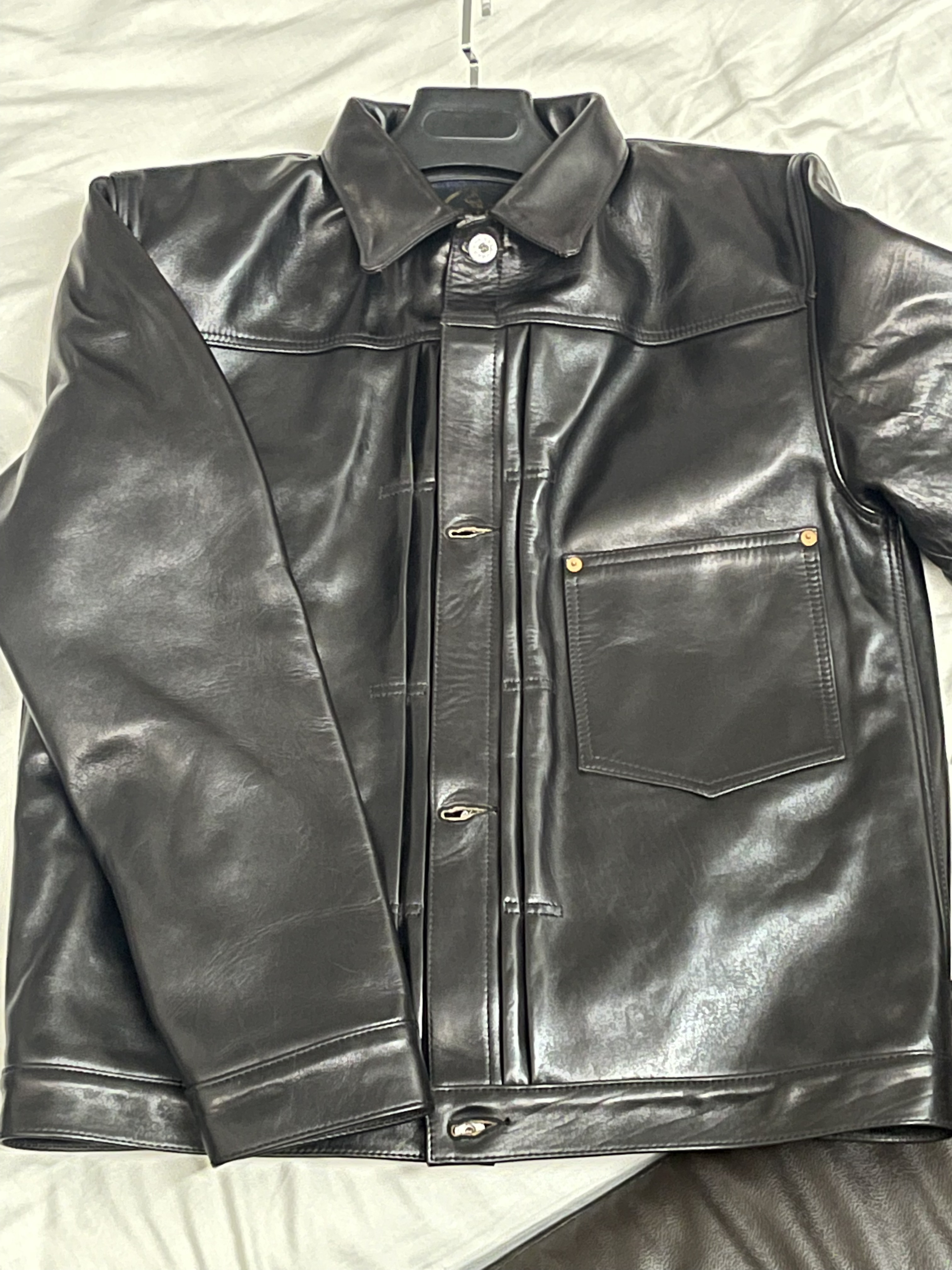
In this article, you will witness my personal debunking of promotional claims and rumors surrounding High Large Leathers. The sample comes from my own purchase of the brand-new Oklahoma City WW2—One Piece Sleeve style, released for the 2024 Summer SS season.
II. Motivation:
Beyond purchasing and wearing leather jackets, I find the leatherworking techniques and pattern-cutting of these garments far more fascinating—a research journey that excites me immensely. Recently, I noticed a particularly eye-catching brand: High Large Leathers. This brand shares the same founder as the renowned Fine Creek Leathers—Yoshikatsu Yamazaki. It served as the precursor to FCL and was revived by Yoshikatsu Yamazaki in 2022, with HLL re-registered under his name. Rumors abound that he possesses the world's finest horsehide leather, and that every HLL piece uses 2.3mm-thick horsehide—such claims set my heart racing. Thus, I began scouring both Chinese and English-language internet sources for all available information on the HLL brand, eventually purchasing a piece myself as a Christmas gift to verify these claims. Regrettably, much high-quality content on the Chinese internet remains inaccessible to the English-speaking world, while the vast majority of Chinese users can access English-language content. This disparity motivated me to write this article, aiming to bridge the information gap and foster exchange among leather enthusiasts.
III. Summary of Rumors Regarding HIGH LARGE LEATHERS
(1) HLL Uses 2.3mm Leather
According to HLL's official Instagram and promotional materials from their Japanese and Chinese distributors, they state that classic denim styles like the 506, 101, and Type 1 use 2.3mm horsehide leather. This leather thickness specification surpasses Fine Creek Leathers' most iconic product—their exclusive 1.8mm leather—and even exceeds the 2.0mm thickness of the leather used in FCL's most renowned item, the Gilmour.
(2) HLL Uses SHINKI Horsehide Leather
This claim originates from Fedora Lounge, which asserts that since FCL uses SHINKI horsehide leather, HLL must also utilize Shin-ki horsehide leather.
(3) HLL employs mud-dyeing techniques
Some Chinese agents state that all black denim leather jackets in HLL's relaunched collection utilize mud-dyeing, achieving a rich charcoal black hue.
(4) HLL jackets run small and buttons are difficult to fasten
This information comes from HLL's UK distributor, who advises selecting one size larger than usual due to consistently smaller sizing. The button fastening issue stems from user discussions noting that buttons of this thickness are nearly impossible to secure.
(5) HLL utilizes the world's finest exclusive horsehide leather
This information originates from a Chinese student studying in Japan. After over five years of in-depth research into Japan's tanning industry and leather jacket brands, he has personally handled and worn over a hundred leather jackets while visiting major Japanese tanneries. He is currently replicating the A2 leather jacket, receiving consistent praise from Chinese leather enthusiasts and collectors. I consider him highly credible in both theory and practice. You can find him online by searching for “东池居士” or “元年皮衣不完全研究” Below, I'll excerpt his analysis. He asserts that the finest horse leather for garments must meet four criteria:
First, it must possess connective tissue and bone structure capable of forming beautiful shapes. Here, I'll clarify: the mention of connective tissue and bones is metaphorical. By connective tissue, I personally interpret him as meaning the horsehide must be sufficiently resilient and possess rich malleability to absorb more oils, thereby achieving the desired effect envisioned by the craftsman. The reference to bones signifies that the leather jacket, like the bones within a body, should provide structural support. Relying on the leather's inherent texture, it should naturally form a crisp, structured silhouette. The combination of these two elements is key to achieving the leather jacket's substantial, fleshy feel.
Second, it must possess the right softness and weight. He believes top-tier leather must prioritize wearability.
Third, it must possess rich grain patterns.
Fourth, it must develop beautiful fading and patina. He notes that the 2.3mm horsehide leather from High Large Leathers (relaunched in 2022) and FCL's 1.8mm to 2.0mm leather meet all four criteria.
IV. Personal Experience and Verification of Claims
(1) HLL Definitely Does Not Meet the 2.3mm Standard
It must be stated that while the thickness of my HLL jacket is satisfactory, it falls far short of 2.3mm. It is thinner than my Schott and Vanson jackets, which are advertised as 1.5mm thick. However, Schott and Vanson's cutting techniques and material usage often result in their leather appearing thicker than advertised. Therefore, I estimate the average thickness of the entire HLL jacket falls between 1.5mm and 1.7mm. While a very small portion of the leather might indeed reach 2.0mm, I am certain it absolutely does not meet the 2.3mm claim. This is quite infuriating, as it is HLL's primary marketing selling point. I inquired with the distributor, who stated that HLL and FCL are too cunning. They only claim to use 2.3mm leather without specifying where it's applied or disclosing the overall average thickness. In short, it absolutely does not reach 2.3mm.
(2) HLL did not use SHINKI horsehide leather
First, based on my hands-on feel, the leather on my jacket clearly lacks SHINKI's characteristic dry texture. Second, according to the field investigation report from the same source (东池居士) mentioned earlier, he located FCL's leather supplier. All leather over 1.8mm thick originates from the Himeji Leather Factory. According to his discussions with the factory, FCL has secured a long-term exclusive agreement for these substantial hides. There are no plans to exhibit these leathers externally, making them highly unlikely for other brands to source in the coming years. Only after persistent requests did the factory agree to sell him 1.3mm horse leather.
(3) HLL does not employ mud dyeing on black leather
This is entirely a misunderstanding by some Chinese distributors. Official promotional materials clearly state “Analine finish,” indicating water-based dyeing without coating. Only items labeled “INDIGO-MUD DYE” utilize mud dyeing, typically priced above ¥400,000. My hands-on inspection also confirms this as standard Analine processing.
(4) HLL leather jackets run small, and buttons are difficult to fasten
According to HLL's official sizing data, the jackets run small—at least one size larger than the stated measurements. Even when Japanese agents list shoulder widths up to 52cm, I personally estimate the shoulder width to be around 48.5cm. The buttons aren't as hard to fasten as imagined; with the right technique—pushing the button upward—they snap into place easily.
(5) Personally, I consider this the finest leather I've ever encountered.
Initially, I was furious—this jacket clearly wasn't 2.3mm thick, and I intended to return it as a clear case of false advertising. Yet I was swiftly captivated by the leather's texture. I've never touched or felt such soft, supple, and substantial horsehide leather. It bears no resemblance to traditional thick horsehide, which often digs into my arms until they're red and sore.
So, I'll describe my experience based on those four criteria.
First, the jacket's thickness truly meets the requirements for shaping, and the garment itself provides excellent structure.
Second, this is the softest horsehide I've ever touched. Without a doubt, it ranks first in comfort among all the horsehide leather jackets I've worn.
Third, the signature FCL horsehide grain pattern—with its distinct growth lines and pebbled texture—is barely visible now. Only the front placket and sleeves retain noticeable traces. The overall aesthetic feels more contemporary, even shedding the brand's signature yin-yang design elements. It's a shame, as that was FCL's most iconic visual signature. The entire jacket has a sleek, glossy finish, eliminating any need to explain why half your jacket is made from belly leather.
Fourth, since mine is brand new, the “patina” isn't yet visible.
Worth noting, this jacket boasts the most stunning sheen I've ever seen—comparable to Italian Maryam leather—and carries a delightful scent: distinctly vegetable-tanned without being overpowering.
V. Afterword:
This is a leather jacket where minor flaws don't overshadow its brilliance. I deeply admire FCL and HLL's tanning expertise—such leather craftsmanship makes HLL irreplaceable. As a Chinese consumer, I've lost all interest in ordinary leather jackets made in Japan, the US, UK, or Greece. In China, I can easily spend less than 50% of the price for these renowned brands yet achieve over 80% of their wearability and aesthetic appeal. I also urge fellow enthusiasts to explore well-regarded Chinese-made leather jackets. You can purchase them with the mindset of buying a sweatshirt, yet I assure you the quality surpasses the entry-level and mid-tier offerings from those famous brands. The only area lacking is meticulous pattern design, which requires long-term aesthetic cultivation and manufacturing expertise to refine. That concludes my sharing. Wishing everyone a Merry Christmas, and I welcome your thoughts and discussions.
In this article, you will witness my personal debunking of promotional claims and rumors surrounding High Large Leathers. The sample comes from my own purchase of the brand-new Oklahoma City WW2—One Piece Sleeve style, released for the 2024 Summer SS season.
II. Motivation:
Beyond purchasing and wearing leather jackets, I find the leatherworking techniques and pattern-cutting of these garments far more fascinating—a research journey that excites me immensely. Recently, I noticed a particularly eye-catching brand: High Large Leathers. This brand shares the same founder as the renowned Fine Creek Leathers—Yoshikatsu Yamazaki. It served as the precursor to FCL and was revived by Yoshikatsu Yamazaki in 2022, with HLL re-registered under his name. Rumors abound that he possesses the world's finest horsehide leather, and that every HLL piece uses 2.3mm-thick horsehide—such claims set my heart racing. Thus, I began scouring both Chinese and English-language internet sources for all available information on the HLL brand, eventually purchasing a piece myself as a Christmas gift to verify these claims. Regrettably, much high-quality content on the Chinese internet remains inaccessible to the English-speaking world, while the vast majority of Chinese users can access English-language content. This disparity motivated me to write this article, aiming to bridge the information gap and foster exchange among leather enthusiasts.
III. Summary of Rumors Regarding HIGH LARGE LEATHERS
(1) HLL Uses 2.3mm Leather
According to HLL's official Instagram and promotional materials from their Japanese and Chinese distributors, they state that classic denim styles like the 506, 101, and Type 1 use 2.3mm horsehide leather. This leather thickness specification surpasses Fine Creek Leathers' most iconic product—their exclusive 1.8mm leather—and even exceeds the 2.0mm thickness of the leather used in FCL's most renowned item, the Gilmour.
(2) HLL Uses SHINKI Horsehide Leather
This claim originates from Fedora Lounge, which asserts that since FCL uses SHINKI horsehide leather, HLL must also utilize Shin-ki horsehide leather.
(3) HLL employs mud-dyeing techniques
Some Chinese agents state that all black denim leather jackets in HLL's relaunched collection utilize mud-dyeing, achieving a rich charcoal black hue.
(4) HLL jackets run small and buttons are difficult to fasten
This information comes from HLL's UK distributor, who advises selecting one size larger than usual due to consistently smaller sizing. The button fastening issue stems from user discussions noting that buttons of this thickness are nearly impossible to secure.
(5) HLL utilizes the world's finest exclusive horsehide leather
This information originates from a Chinese student studying in Japan. After over five years of in-depth research into Japan's tanning industry and leather jacket brands, he has personally handled and worn over a hundred leather jackets while visiting major Japanese tanneries. He is currently replicating the A2 leather jacket, receiving consistent praise from Chinese leather enthusiasts and collectors. I consider him highly credible in both theory and practice. You can find him online by searching for “东池居士” or “元年皮衣不完全研究” Below, I'll excerpt his analysis. He asserts that the finest horse leather for garments must meet four criteria:
First, it must possess connective tissue and bone structure capable of forming beautiful shapes. Here, I'll clarify: the mention of connective tissue and bones is metaphorical. By connective tissue, I personally interpret him as meaning the horsehide must be sufficiently resilient and possess rich malleability to absorb more oils, thereby achieving the desired effect envisioned by the craftsman. The reference to bones signifies that the leather jacket, like the bones within a body, should provide structural support. Relying on the leather's inherent texture, it should naturally form a crisp, structured silhouette. The combination of these two elements is key to achieving the leather jacket's substantial, fleshy feel.
Second, it must possess the right softness and weight. He believes top-tier leather must prioritize wearability.
Third, it must possess rich grain patterns.
Fourth, it must develop beautiful fading and patina. He notes that the 2.3mm horsehide leather from High Large Leathers (relaunched in 2022) and FCL's 1.8mm to 2.0mm leather meet all four criteria.
IV. Personal Experience and Verification of Claims
(1) HLL Definitely Does Not Meet the 2.3mm Standard
It must be stated that while the thickness of my HLL jacket is satisfactory, it falls far short of 2.3mm. It is thinner than my Schott and Vanson jackets, which are advertised as 1.5mm thick. However, Schott and Vanson's cutting techniques and material usage often result in their leather appearing thicker than advertised. Therefore, I estimate the average thickness of the entire HLL jacket falls between 1.5mm and 1.7mm. While a very small portion of the leather might indeed reach 2.0mm, I am certain it absolutely does not meet the 2.3mm claim. This is quite infuriating, as it is HLL's primary marketing selling point. I inquired with the distributor, who stated that HLL and FCL are too cunning. They only claim to use 2.3mm leather without specifying where it's applied or disclosing the overall average thickness. In short, it absolutely does not reach 2.3mm.
(2) HLL did not use SHINKI horsehide leather
First, based on my hands-on feel, the leather on my jacket clearly lacks SHINKI's characteristic dry texture. Second, according to the field investigation report from the same source (东池居士) mentioned earlier, he located FCL's leather supplier. All leather over 1.8mm thick originates from the Himeji Leather Factory. According to his discussions with the factory, FCL has secured a long-term exclusive agreement for these substantial hides. There are no plans to exhibit these leathers externally, making them highly unlikely for other brands to source in the coming years. Only after persistent requests did the factory agree to sell him 1.3mm horse leather.
(3) HLL does not employ mud dyeing on black leather
This is entirely a misunderstanding by some Chinese distributors. Official promotional materials clearly state “Analine finish,” indicating water-based dyeing without coating. Only items labeled “INDIGO-MUD DYE” utilize mud dyeing, typically priced above ¥400,000. My hands-on inspection also confirms this as standard Analine processing.
(4) HLL leather jackets run small, and buttons are difficult to fasten
According to HLL's official sizing data, the jackets run small—at least one size larger than the stated measurements. Even when Japanese agents list shoulder widths up to 52cm, I personally estimate the shoulder width to be around 48.5cm. The buttons aren't as hard to fasten as imagined; with the right technique—pushing the button upward—they snap into place easily.
(5) Personally, I consider this the finest leather I've ever encountered.
Initially, I was furious—this jacket clearly wasn't 2.3mm thick, and I intended to return it as a clear case of false advertising. Yet I was swiftly captivated by the leather's texture. I've never touched or felt such soft, supple, and substantial horsehide leather. It bears no resemblance to traditional thick horsehide, which often digs into my arms until they're red and sore.
So, I'll describe my experience based on those four criteria.
First, the jacket's thickness truly meets the requirements for shaping, and the garment itself provides excellent structure.
Second, this is the softest horsehide I've ever touched. Without a doubt, it ranks first in comfort among all the horsehide leather jackets I've worn.
Third, the signature FCL horsehide grain pattern—with its distinct growth lines and pebbled texture—is barely visible now. Only the front placket and sleeves retain noticeable traces. The overall aesthetic feels more contemporary, even shedding the brand's signature yin-yang design elements. It's a shame, as that was FCL's most iconic visual signature. The entire jacket has a sleek, glossy finish, eliminating any need to explain why half your jacket is made from belly leather.
Fourth, since mine is brand new, the “patina” isn't yet visible.
Worth noting, this jacket boasts the most stunning sheen I've ever seen—comparable to Italian Maryam leather—and carries a delightful scent: distinctly vegetable-tanned without being overpowering.
V. Afterword:
This is a leather jacket where minor flaws don't overshadow its brilliance. I deeply admire FCL and HLL's tanning expertise—such leather craftsmanship makes HLL irreplaceable. As a Chinese consumer, I've lost all interest in ordinary leather jackets made in Japan, the US, UK, or Greece. In China, I can easily spend less than 50% of the price for these renowned brands yet achieve over 80% of their wearability and aesthetic appeal. I also urge fellow enthusiasts to explore well-regarded Chinese-made leather jackets. You can purchase them with the mindset of buying a sweatshirt, yet I assure you the quality surpasses the entry-level and mid-tier offerings from those famous brands. The only area lacking is meticulous pattern design, which requires long-term aesthetic cultivation and manufacturing expertise to refine. That concludes my sharing. Wishing everyone a Merry Christmas, and I welcome your thoughts and discussions.